
The 15 Traits of Orality
“Orality is holistic communication embodied in relationships that create socio-cultural identities and practices.”1
Andy: Do you like chicken?
Susan: Sure, I love to eat chicken!
Andy now knows that Susan loves chicken. Still, there are hundreds of chicken recipes out there, and Andy could still get it wrong if he had to cook for Susan.
Then we talk about a people group’s orality; we only have a general idea about how they are. Orality comes in different flavors, and we must look deeper than just thinking that storytelling will be a good method to reach them. The traits of orality help us understand a people’s orality reliance in more detail.
The word “traits” is typically used to refer to distinguishing qualities, characteristics, or features that define or describe someone or something. It is often used to describe individual attributes, behaviors, or patterns of thought that are considered typical or distinctive of a person, animal, or object. In this sense, we ask: What traits are common for oral-preference learners or oral cultures?
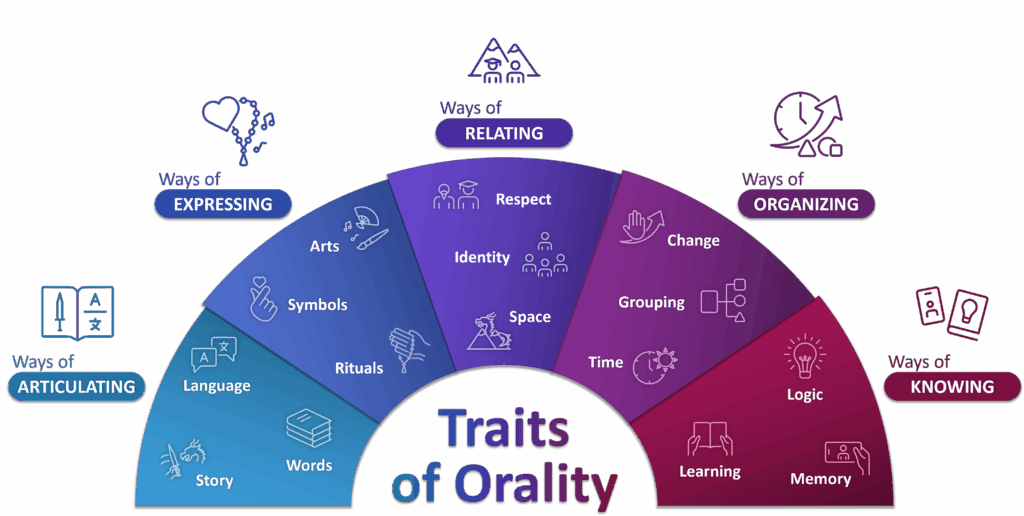
During our study of oral cultures, we identified 15 traits of orality. To make these easier to understand, we’ve grouped them into 5 clusters. While these categories are based on Walter Ong’s psychodynamics of orality,2 we’ve also included additional research from scholars like Geert Hofstede3 to create a more comprehensive picture.
We recognize that there is some overlap between these traits and that they could fit into multiple clusters. Our goal in categorizing them is to provide a valuable framework for our survey, but we acknowledge that there are other ways of understanding orality. Ultimately, we hope this framework will help us better understand the unique qualities of oral cultures and how they shape communication and interaction.
Take the survey and learn more about the traits of orality of your people group.
The 5 Clusters
- Ways of Articulating
 The orality traits linked to language, story, and words that help people articulate the things around us so that we gain a shared understanding. People tend to think more generally/descriptively on one side of the lingual spectrum. On the other side of the spectrum, people…
 - Ways of Expressing
 How we display our inner speech through arts, rituals, and symbols. They generate the power to penetrate the heart and transform the mind by engaging all senses. On one end of the spectrum, people generally tend to immerse themselves in the medium of their own…
 - Ways of Relating
 The orality traits of identity, respect, and space describe our connectedness within our world and community. People generally function more holistically on one side of the spectrum – they are a part of the whole. On the other side of the spectrum, people tend to…
 - Ways of Organizing
 The traits that describe our sense of time, need for change, and how we group things in our world. They represent how we tend to frame and manage the patterns and movement of life together. On one side of the spectrum, people generally frame things…
 - Ways of Knowing
 These traits require a more complex set of factors. They represent how we capture and process a message, how people really learn, and their preferred ways of remembering a message. On one side of the spectrum, people gravitate to familiar patterns, repetition, and non-linear logic.…
The 15 Traits
Ways of Articulating
- Language
 A communication system structured in vocabulary and grammar expressed through sounds, symbols, gestures, and other non-verbal cues. Language is passed…
 - Story
 The human capacity to create and share narratives of all kinds. They serve as a vehicle to receive, process, remember,…
 - Words
 Building blocks of a language describing local realities for shared understanding and expression. The evolving speech and multiple literacies bond…
Ways of Expressing
- Arts
 The innate creative capacity to express our inner speech through all our senses. Typically people think of arts by referring…
 - Rituals
 It encompasses several other traits of orality. They act out and convey collective meaning to successive life events (weddings, graduations).…
 - Symbols
 It includes words, signs, colors, gestures, pictures, metaphors, rituals, etc., and embodies an idea, object, or relationship. Some cultures predominantly…
Ways of Relating
- Identity
 How individuals or groups perceive and define themselves and others. Most clearly, it relates to how a people group looks…
 - Respect
 It relates to the level of admiration for others. It may be ascribed, confirmed, or earned on qualities, achievements, or…
 - Space
 The sum of all the interacting living things (material and non-material), non-living elements, and the surrounding environment, and how they…
Ways of Organizing
- Change
 How people value innovation. That may include ideas, teachings, or technologies that affect their daily life and processes. Story: Electrifying…
 - Grouping
 Patterns by which we holistically structure and arrange our world. This includes how we classify and categorize our physical, mental,…
 - Time
 The created sequential dimension in which we experience life in the eternity of God. Story: Deal or No-deal? Tom: We…
Ways of Knowing
- Learning
 A pathway for people to construct knowledge, acquire skills, and develop attitudes. Learning domains include cognition, affection, and behavior leading…
 - Logic
 How our brain receives, interacts with, and makes sense of information, stimuli, and data. We then filter and synthesize it…
 - Memory
 How individuals or groups process and store information, experiences, and data (received through all senses) for future recall. Story: Living…
- Qalb, Danyal. Weaving the Maguindanao Story of Tradition, Faith & Education through Orality. Manila, Philippines: OralityResources.International, 2025.
↩︎ - Walter J Ong, Orality and literacy: the technologizing of the word (London: NY: Routledge, 2002), 31–55. ↩︎
- Geert Hofstede, Gert Jan Hofstede, and Michael Minkov, Cultures and Organizations: Software of the Mind; Intercultural Cooperation and Its Importance for Survival, Rev. and expanded 3. ed (New York: McGraw-Hill, 2010). ↩︎